

A Dispatch from the Edge of Understanding
Oratorio for the Living Things

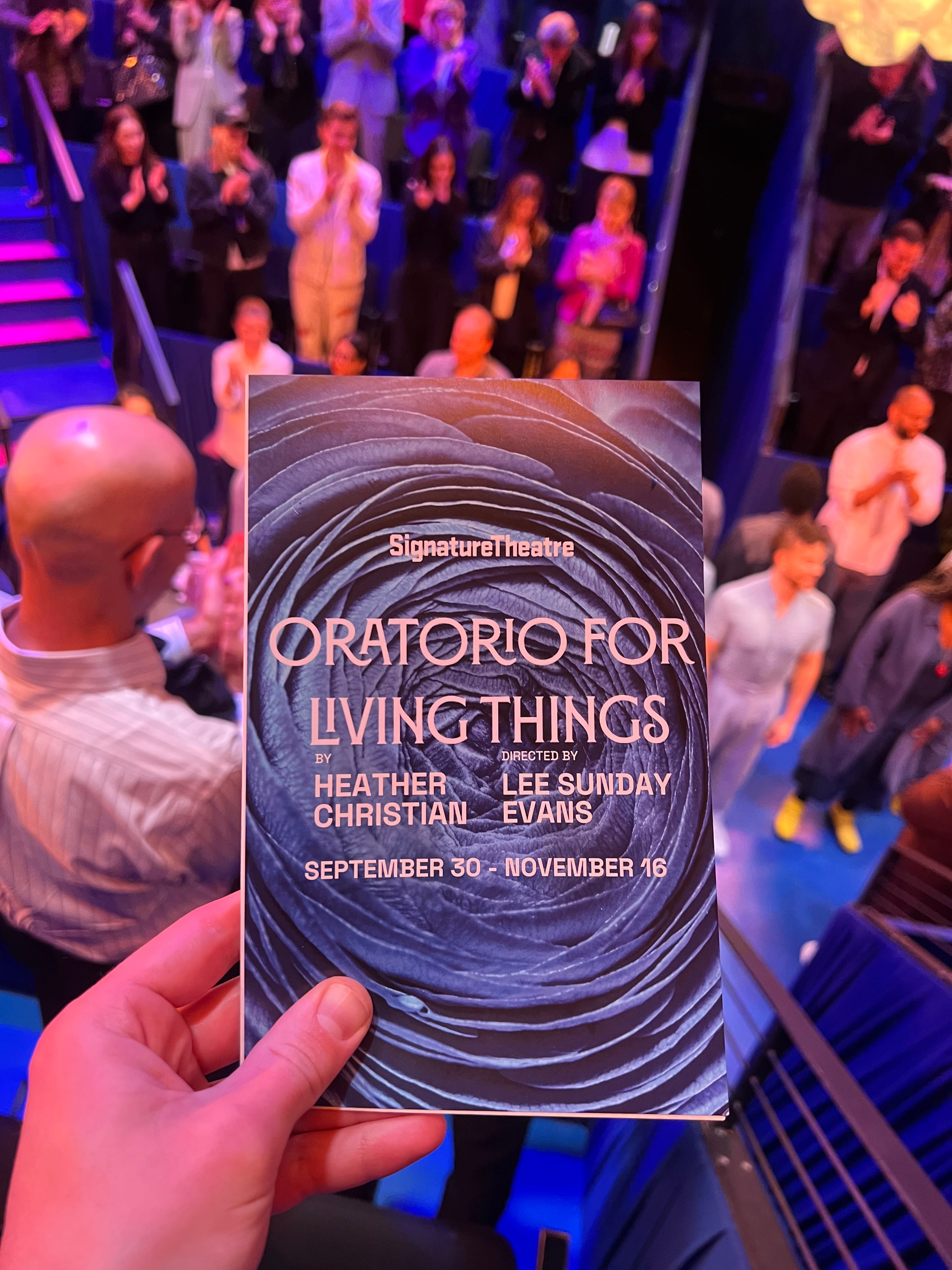
Tonight I had the not-un-rare New York experience of going to the opening night of a new musical-play and not understanding what happened.
The playwright included a nice note in the program, which was helpful in breaking down the three acts of the intermissionless play.
However, with one-third of it in Latin—and the rest in what I would describe as somewhere between psychosis and poetry—I know the play was not meant for me. It was what The New York Times has described as: “profoundly strange and overwhelmingly beautiful.”
And that’s not an insult. It’s just an observation.
There’s a long New York tradition of attending something both transcendent and incomprehensible. When it ends, we clap because the actors are talented, the staging is inventive, and the lighting cues are tight; but also because the social contract of New York theatergoing demands it.
Still, Oratorio for the Living Things asks something different of its audience. It doesn’t want applause; it wants complete and total surrender.
The Cathedral and the Wi-Fi
The production, a choral work weaving Latin liturgy, modern idioms, and an unrelenting wash of sound, felt like standing in a cathedral where someone left the Wi-Fi on.
“In principio erat verbum.”
In the beginning was the Word.
And then, seconds later:
“I remember the static on the radio.”
That collapse, between the sacred and the banal, was at the play’s heartbeat.
It throbbed with the tension of a meaning that was slipping just out of reach.
There were moments, both fleeting and crystalline, when it all came together. When a single soprano pierced through the dense soundscape and you thought, Ah, there it is. The meaning.
And then it dissolved again.
When Comprehension Fails
But I think that was the point. In an age of infinite information, clarity itself has become a kind of luxury.
“We build patterns to survive,
but they break,
and we begin again.”
I didn’t understand the play, but I did feel it. And at times, I felt myself welling up on the edge of tears:
The vibrations of the human voice.
The proximity of strangers breathing the same air.
The attempt, however futile, to say something about the living condition.
Because if Hamilton was a TED Talk with choreography, Oratorio is a poignant séance conducted by poets.
And maybe, in 2025, that’s what art should be: not something we decode, but something that disorients us just enough to feel alive again.
“All things sing, even as they end.”
As that line echoed through the space, I realized I’d stopped trying to follow and had simply started existing in time with the music.
The Takeaway
I walked out into the autumn air unsure of what I’d witnessed, but certain it meant something. And in this city, sometimes that’s enough.
But hey, what do I know? If you’ve ever left a theater confused but somehow changed, you’re my kind of reader. Subscribe to ARK Strategy for dispatches from the borderlands of work, (sometimes art) and meaning: where comprehension gives way to curiosity, because curiosity is what, after all, keeps us human.
Artists are here to disturb the peace. We won't always understand it, but it leaves a mark.
This captures that singular New York moment perfectly - where art teeters between the profound and the perplexing, and you’re not entirely sure which side you’re