

So Who Reads "ARK Strategy" Anyway?
What 2,100 subscribers and 3,379 LinkedIn followers reveal — and the one number that reframes this entire project.


Every writer eventually does the thing I’m about to do, which is open the analytics dashboard and look at the numbers. It’s a highly undignified ritual. You tell yourself you’re studying the audience; what you’re really doing is asking the data to confirm that the work matters to someone.
I wanted to resist that, and so I exported everything — the full list, the LinkedIn demographics, six months of opens and clicks — and tried to read it the way I’d read a client’s data rather than my own. Think of it like everything else we do here ARK Strategy… it’s the honest version.
And what I uncovered is a story about two very different rooms, the gap between them, and what that gap is telling me to do next.
So now, let me show you:
Two Audiences, Not One:
The first thing to understand is that ARK Strategy doesn’t have an audience. It has two, and they barely even overlap.
There is the Substack list — 2,100 people, scattered across roughly forty countries, who arrived mostly by accident of the platform’s own machinery.
And there is the LinkedIn audience — 3,379 followers, concentrated, senior, and clustered around money in a way the Substack list is not. One is wide and global and lightly attached. The other is narrow and local and, in professional terms, expensive.
I’d been treating these as the same project wearing two outfits. But they aren’t… and once I stoped pretending they’re the same, almost everything about what to do next gets much clearer.
Where the Subscribers Actually Come From:
Let’s start with an uncomfortable fact. Of the 2,100 names on the list, 1,131 (a little more than half) were an imported launch list. They didn’t find ARK Strategy. I brought them with me. But I’d like to preface this with the following; every newsletter starts by emptying its own contacts into the machine.
However, this then means the real question is about the other 969 — the people who joined since, organically (and on purpose).
So where did they come from?
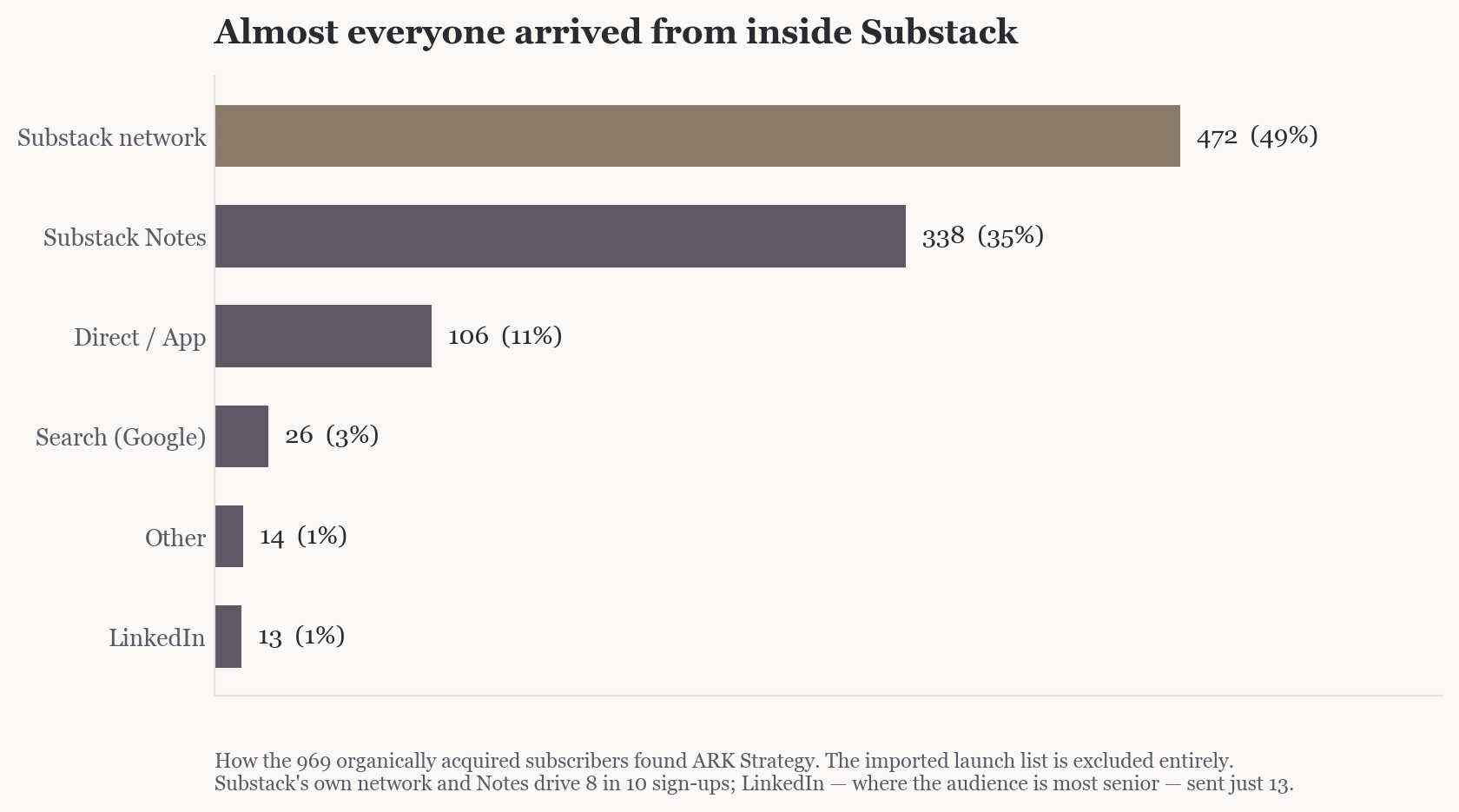
The answer is almost entirely Substack itself. The Substack network, whether recommendations, the app, reader discovery, sent 472 subscribers. Notes sent another 338. Between them, that’s more than 80% of organic subscribers arriving from inside the walls. Direct avenues and search engines are a rounding error. And LinkedIn — the platform where I post most deliberately, where the audience is most senior, where I have 3,379 followers — sent just thirteen.
Thirteen.
I want us to sit with that, because the superficial reading is “LinkedIn doesn’t work” and that’s not entirely it either. What the number actually shows us is that the two platforms do entirely different jobs.
Substack is where the subscribing happens: it’s built, end to end, to convert a reader into an email address. LinkedIn is not, and never was. Asking LinkedIn to drive subscriptions is like asking a dinner party to function like an auto mechanic. It is doing something; it’s just not doing that thing.
Which raises the obvious question: if LinkedIn isn’t the funnel, then what is it?
A New York Newsletter with a Global List
Here is the Substack list by geography, for the 969 subscribers whose location I can glean:
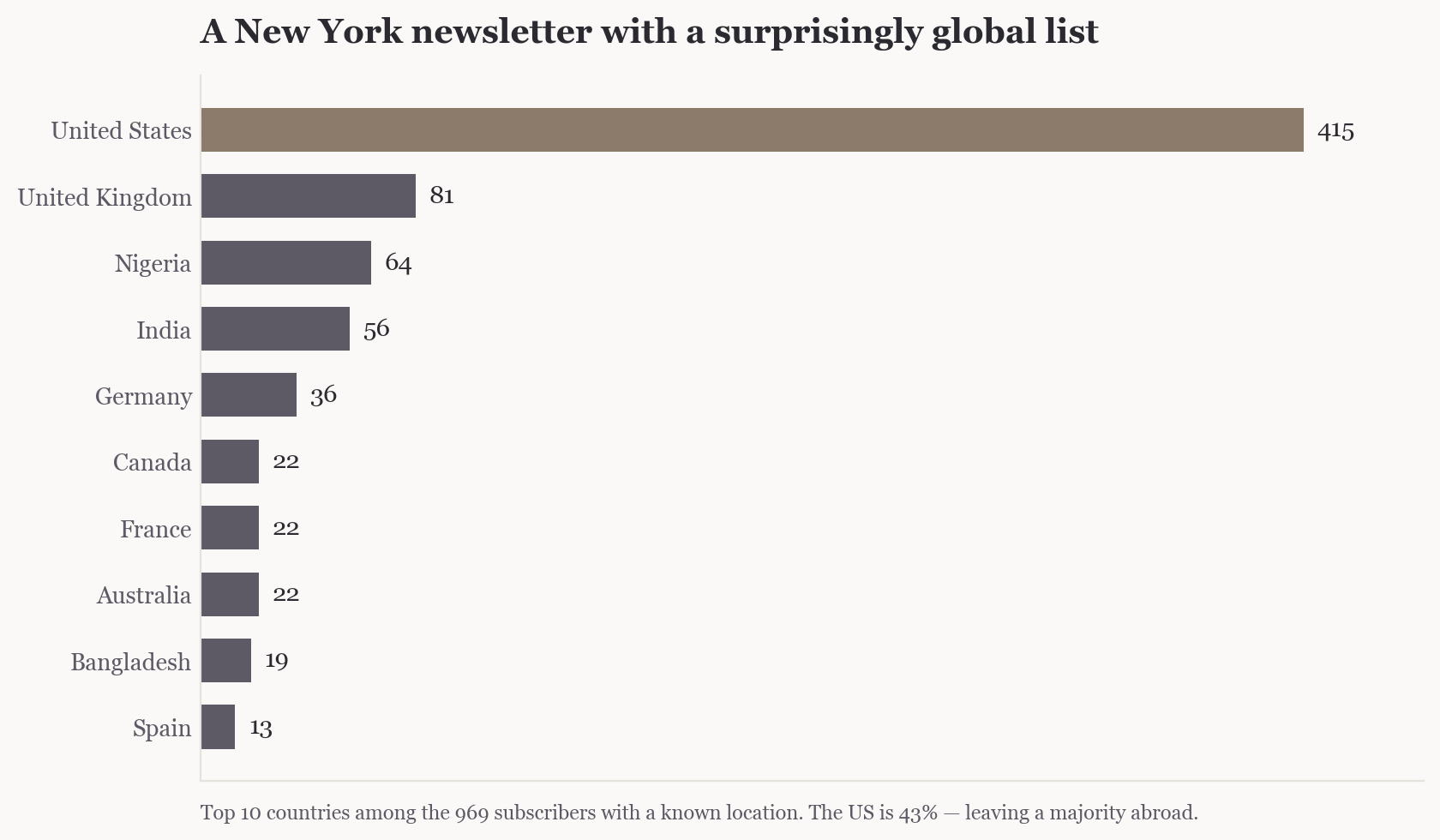
The United States is the plurality at 43% — but that means a clear majority of this list lives somewhere else. The United Kingdom, Nigeria, India, Germany, Canada, Australia, France, Bangladesh. This is a genuinely international readership for a newsletter written by someone in Brooklyn about, largely, the American knowledge economy.
I find this both flattering and clarifying. Flattering, because the ideas evidently travel — the “portfolio career”, the shrinking floor, the question of what compounds across a non-linear life are not unique concerns. But that’s also partly clarifying, because it tells me something about what I’ve been saying.
A reader in Lagos or Dhaka who found me through a Substack recommendation is a real reader. (Hello!) They are also, in all likelihood, never going to wire me money for fractional strategy work in the New York metropolitan area. The Substack list is the idea’s reach. It is not the business’s pipeline. Those are different things, and I’ve been conflating them for some time now.
The LinkedIn Room is the One That Can Realistically Afford Me…
Now look at the other audience. Here LinkedIn’s own demographics tell a story the Substack export never could:
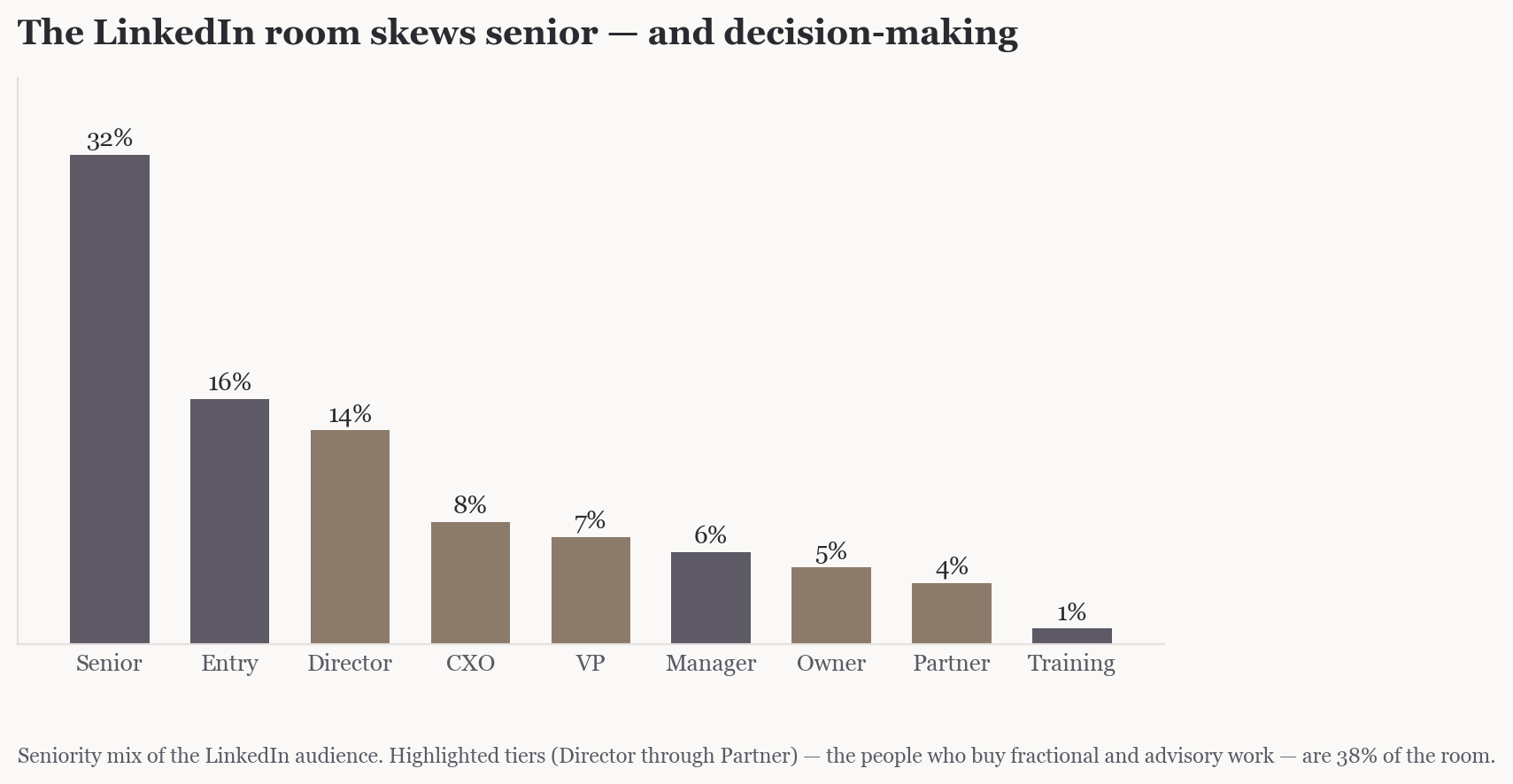
Nearly a third of the LinkedIn audience is at the “Senior” level. Stack up Director, CXO, VP, Owner, and Partner on top of each other — the tiers that actually hold a budget and sign for outside help — and you get 38% of the audience! These are not aspiring operators reading to learn the game. A meaningful share of them are the game. They are the people who hire fractional executives, who retain advisors, who put a strategist in the room before a board meeting.
And look at where they work:
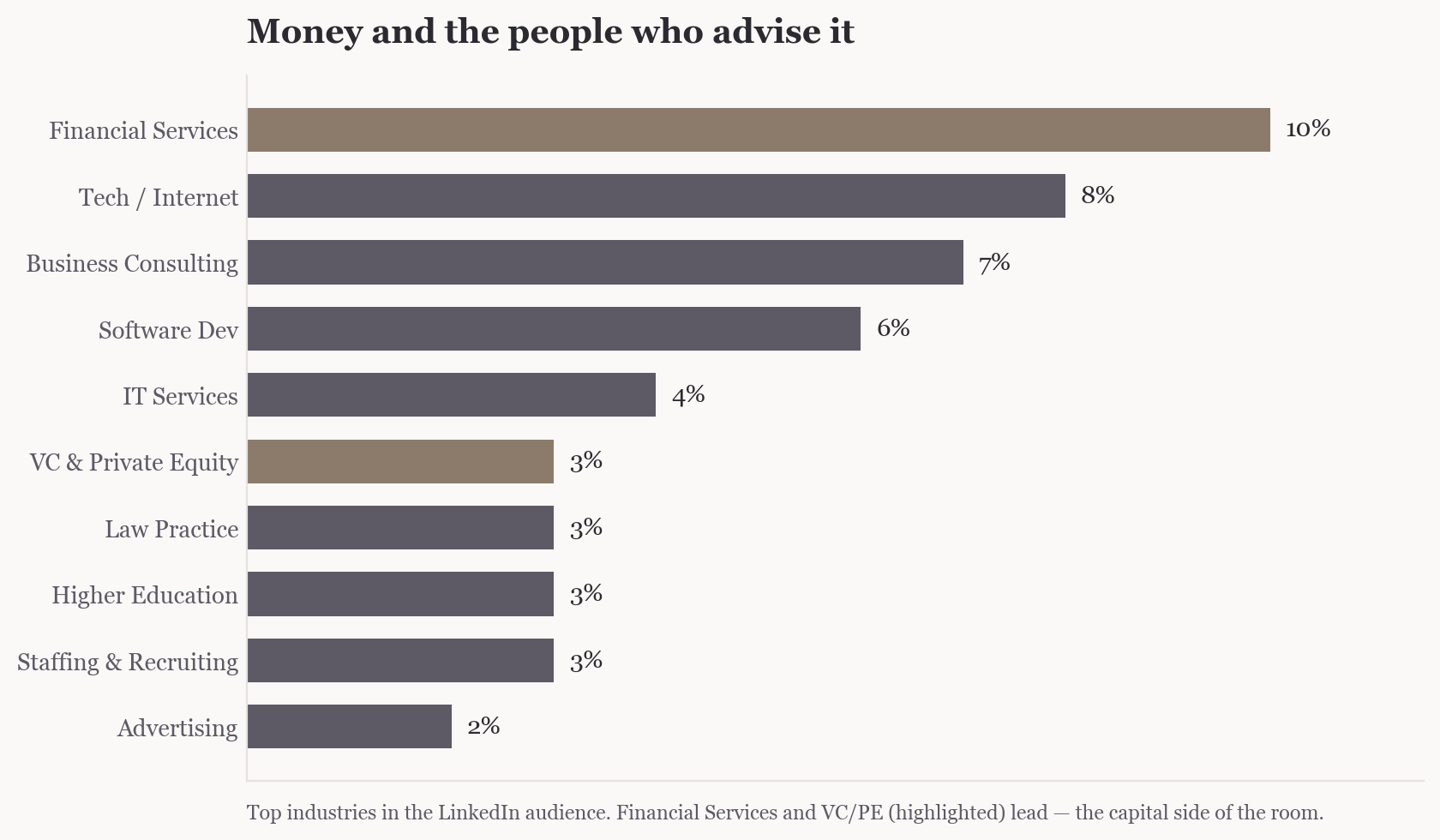
Financial Services leads at 10%, with Venture Capital and Private Equity adding more. Then technology, consulting, software. This is the capital side of the economy and the people who advise it — and geographically, 39% of the LinkedIn audience sits in the New York City metropolitan area, with Boston, London, and the Bay Area behind it. For big brand names: JPMorganChase, Citi, Columbia, and Google all show up by name.
This is the room that can afford APR Strategic Consulting. It is not the room subscribing to the newsletter. It’s the room watching the newsletter… and that distinction is, as they say, “the whole shebang.”
The Substack list reaches the world. The LinkedIn audience reaches the buyers. And I’ve been measuring the wrong one as the metric of my success.
The Number that Reframes Everything
Let me put the engagement story plainly, because it’s where the self-flattery will promptly end: of everyone who received an email in the last six months, 75% of you opened at least one!
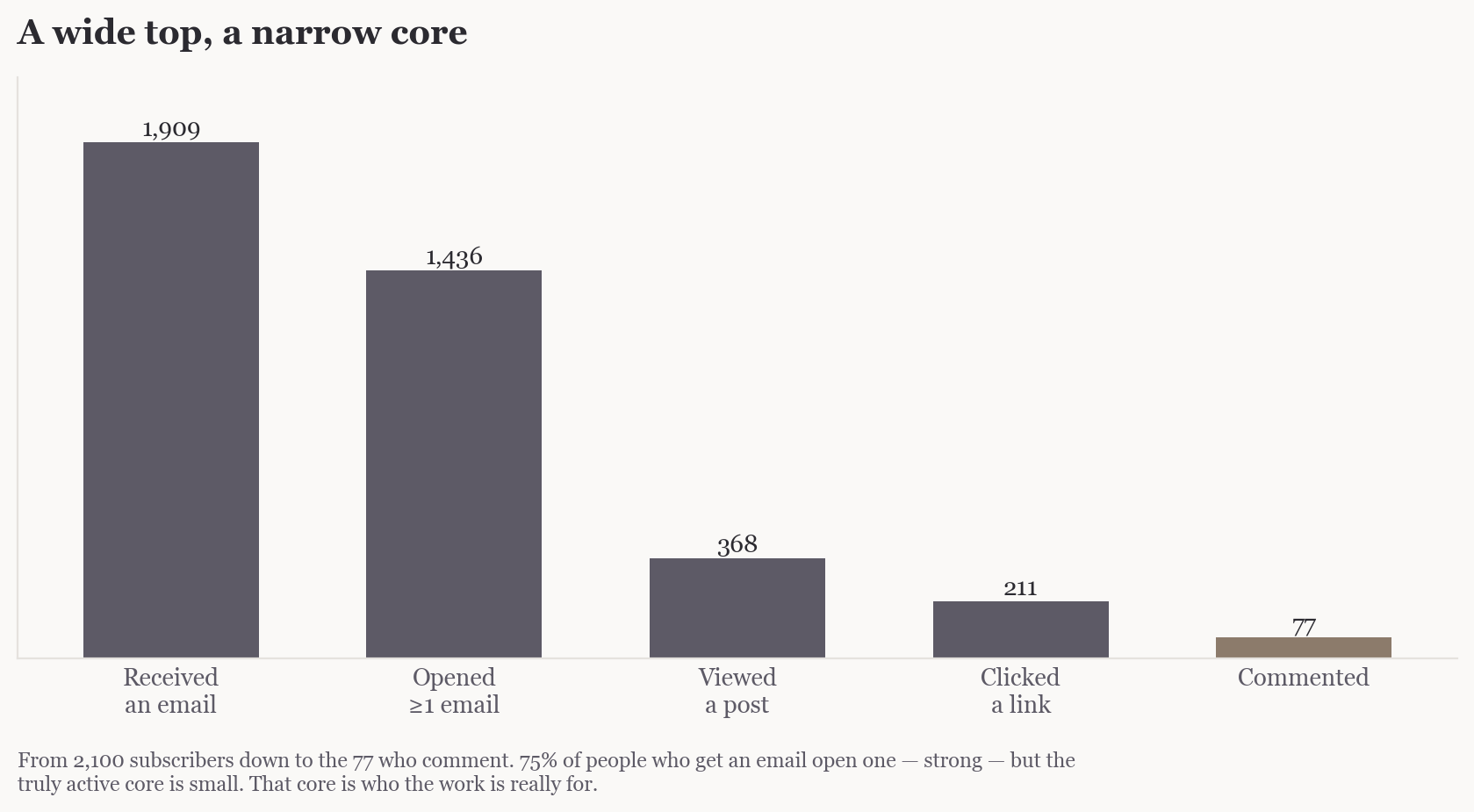
That’s a genuinely strong rate, and it tells me the people on this list (mostly) want to be there! The list is, in itself, not dead. Huzzah!
But watch the funnel narrow: 1,909 received an email; 1,436 opened one; 368 clicked through to read a post on the site; 211 clicked a link; And 77 — seventy-seven people, out of twenty-one hundred — left a comment. Just 47 subscribers shared something.
The truly active core of ARK Strategy is not 2,100 people. It is closer to 200, with a beating heart of about 77 superfans. And here’s the part that led me to, on reflection, pause for a moment. That number is just fine. In fact, it’s exactly how newsletters are supposed to function.
I’m curious, are you one of the 77? Reply to this email or comment below. It will land in my inbox.
That shrinking floor I keep writing about — the idea that the bottom of every profession is being competed away while the genuinely engaged top holds its value — applies to this readerships too! The wide top of the funnel is its reach. The narrow core is the relationship. The work isn’t really for the 2,100. It’s really for the loyal 77, and for the senior 38% on LinkedIn who never comment but are absolutely paying attention…
What I’m Doing Next…
So here’s an honest laundry list of what comes next:
Stop asking LinkedIn to be a subscribe button: It sends thirteen subscribers and that’s not its job. Its job is to keep the senior, NYC-finance, decision-making audience warm: the people who become consulting clients, not newsletter opens. I’ll measure LinkedIn on that, on conversations started and work won, not on the subscriber counter.
Feed the machine that actually feeds me: Eight in ten organic subscribers come from inside Substack: Notes and the recommendation network. That’s the growth engine, full stop. More Notes, more cross-recommendations, more of the work that compounds on-platform.
Write to the 77, not the 2,100: The comment-and-share core is small, senior, and real. The temptation with a global list is to flatten the writing toward the largest common denominator. In the age of AI, the data says do the opposite. Go deeper, be more specific, trust that the people who matter are the ones already leaning in…
Stop confusing reach with revenue: The Substack list is the idea’s footprint. The LinkedIn audience is the business’s pipeline. They are two different assets and I’ll manage them as two different assets moving forward. Like I’ve been saying all along, a career is a portfolio, not just one job. It turns out an audience is too…
I went into the data dump because I was genuinely curious. What I got in the end was a set of instructions: the people I’m trying hardest to reach aren’t the ones I should be writing for, and the platform I’m working hardest on isn’t the one that’s even working for me. The numbers aren’t meant to flatter. However, they do one better:
They tell me, in the end, where to point the scarcest of all commodities: the flashlight of my attention.
-ARK
Alex Randall Kittredge writes the Substack ARK Strategy and is the founder and Managing Director of APR Strategic Consulting. He has advised 9+ CEOs, integrated workforces, and redesigned organizations across hedge funds, startups, and industrial companies. He is a graduate of Columbia University and the University of Cambridge, and mentors entrepreneurs & startup founders through Oxford Entrepreneurs Network, CamEntrepreneurs, and Plug and Play Tech Center. He is a Director of The Oxbridge Method Ltd, and is the author of the forthcoming book, How Your Side Hustles Will Save You: Creating a Durable Career that Transcends the Corporate Ladder. Connect on LinkedIn.
Methodology: Subscriber figures are drawn from the ARK Strategy subscriber export (n=2,100, retrieved June 4, 2026). LinkedIn demographic and reach figures are drawn from LinkedIn’s aggregate creator analytics for May 30–June 5, 2026 (3,379 followers; 15,181 impressions; 11,194 members reached). Geography and channel percentages for the Substack list are calculated on the 969 subscribers who joined organically. Engagement metrics cover a trailing six-month window.
Compliance Statement: All views and opinions expressed are solely my own and do not reflect those of any current or former employer, client, or organization with which I am or have been affiliated.
The 77 who comment and share are worth more than the 2,100 who quietly skim.
Excellent deep dive into your stats